
Woven Stories
Stitching Together Perception and Interpretation

Stories are everywhere. They are what make the world tick - from the beginning to the end and back to the beginning all over again. Stories fuel our perception, running out our imagination, from one unique perspective to another. Logic and objective fact may (or may not, depending on a person's opinion) be at the centre of all things, but the eyes perceiving it will always differ from another set of eyes. We all have stories running through our minds of the world, of other people, and of ourselves. True or not, as this is not what we have come here to discuss, these stories are what keeps us moving forward, but equally again they are also what keeps us in the past. They are woven into our worlds, left in remnants that arrive to us changed and transformed, and maybe a little damaged.
Telling these stories can add to the stories we are already focusing on - they can reveal what has not been looked to yet and can help us to understand better what we already know of the world. Stories hold messages and meaning, something which many people are looking for in their lives in order to find purpose and belonging. And so I offer a story here for you, and plenty more to come, of how meaning has found its way into the very fabric and material of a dirty rag, a moth-eaten scrap, that when unfolded becomes the wardrobe of an ordinary person living an ordinary life centuries into the past.
A Beginning
When I went on a day trip to Oxfordshire researching deliberately concealed garments for my Masters degree, I purposefully went to look at two objects. The first was a pocket, an eighteenth century detachable pocket, kept at a museum resource centre. Pockets at this time were made separately to the gown of a garment and worn tied around the corset hidden beneath layers of skirts or petticoats - a natural concealer of items that became concealed itself. The second was a jacket, made for a young boy in fact and so it was predictably small in stature, ordinary for the time and for the type of family it belonged to. What I saw in these two objects were stories unimaginable of the people who owned these objects and of people who concealed them. The pocket had notes, letters, and coins tucked inside of it already, and yet they all dated from different points in time from the lifespan of the house it was discovered in. It drew me a picture of a person, perhaps a woman, a maid, a young girl even, finding old coinage and notes hidden within the house and using her pocket to keep them hidden. Perhaps though it was even the other way around, pocket first and innumerable treasures later united with another object tied to the history of the house. The silent acts of past inhabitants are unknowable to us now and so there are only stories left to tell of their occurrence.
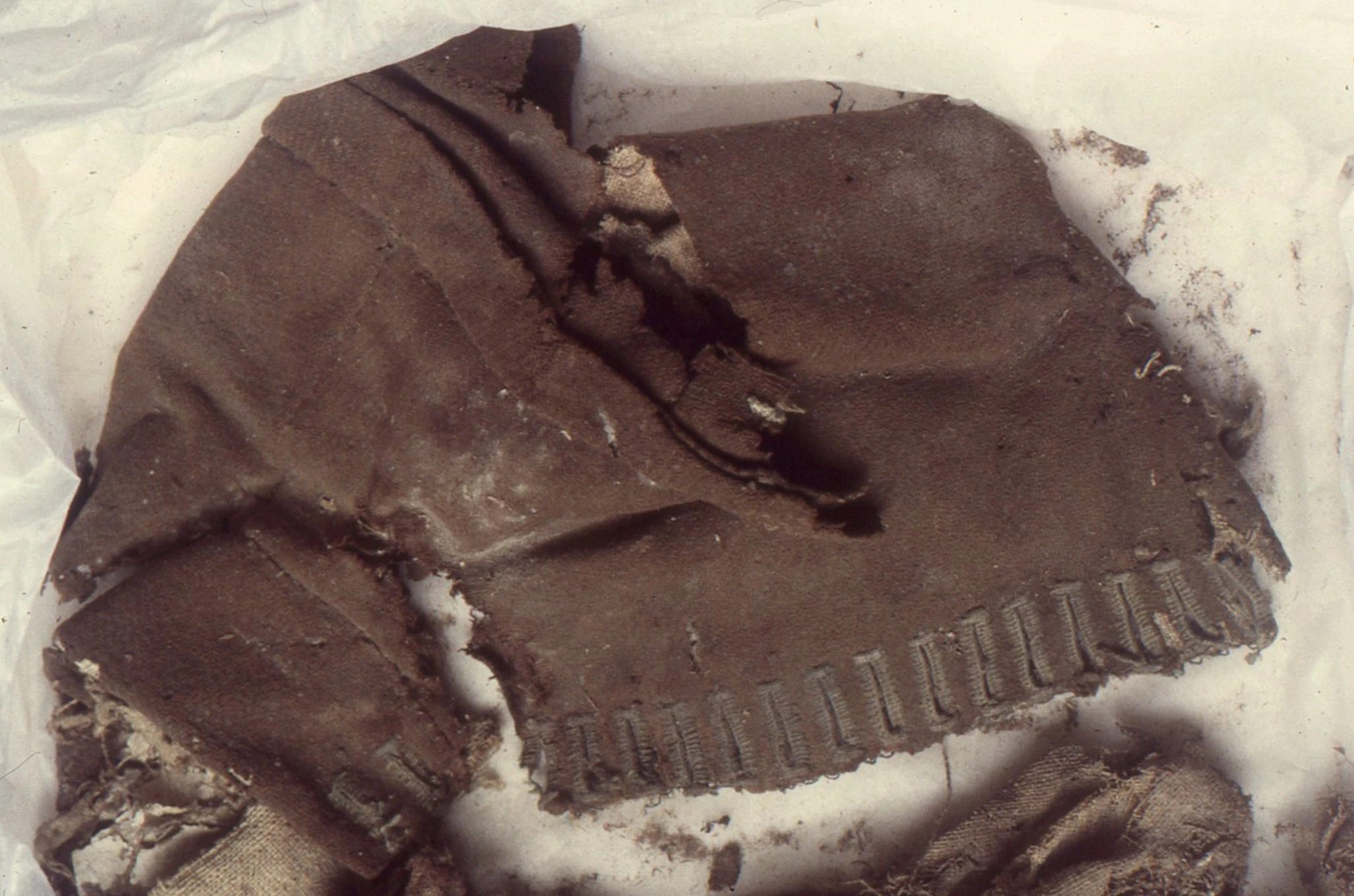
The young boy brought to the surface something even more powerful. It might not have even been the boy who concealed his jacket. One theory for the concealment of clothes in buildings is the practice of ritual concealment, used as apotropaic devices to protect the inhabitants from spiritual threats beyond their own understanding. It could have been plausible that the boy himself had passed and the remaining family members, whoever they may be, concealed his jacket to spiritually protect the living as well as the dead. A memory of a person, a spirit even, remaining in physical form; a well of grief and familial love in the simple act of concealing a memory away with the house forever.
A Middle
These stories are wrapped up in the hidden cavities of an enduring wall, rebuilt and remade over centuries, wrapped up again by a house, or a home, standing the test of time and the inevitable changes of historical life they survive to witness. Captured within these stories are the boundaries of the physical - the physical body personified by garment or shoe, by extension the building or home, and the physical spaces shaped by individual worlds, bound within a physical object. Dinah Eastop, conservator and a primary scholar in the research of deliberately concealed garments, states that these objects 'draw attention to the unseen, and largely ignored parts of buildings'.1 By revealing these stories, and unwrapping the walls of a building enclosing these garments, brings to the light what was once concealed, and with it the mysteries, the secrets, the purpose behind a folkloric practice unknown to current common knowledge. Thus, hidden within the physical is a world of the spiritual, of the intellectual, and the emotional. Inside of these objects is concealed again, to our limited view, meaning that exists beyond these physical boundaries, perhaps even meaning that roots these objects in time as to endure in its purpose. That is how they arrive to us, persistent and surviving, in hidden forms as was intended. They are carried within these physical boundaries, or what still remains of them, to our present moment with the metaphysical superimposed into its very foundations, into the fabric of a home and its inhabitants.
It becomes clear that there is an integral relationship between the physical spaces of concealment and the object that is ultimately concealed. These are stories not only of a piece of clothing, personal and possessive, hidden away everlasting - the last thing many expect to see when refurbishing their house - but also of a house as domestic setting, protective shelter, and social participant, stories which are central to understanding the people connected to both.
Bringing these stories to the forefront even if they may still be hidden is important to understanding how these objects came to be concealed within the foundations of a house. Edward Hollis, architect and author of The Secret Lives of Buildings and The Memory Palace: A Book of Lost Interiors, accentuates the stories of buildings that have been lost, changed, diminished or even destroyed, and of interiors that reflect the innermost workings of a person's mind.2 These stories are central to understanding the secret, hidden histories of everyday life within these homes, within these clothes, where 'incremental change has been the paradoxical mechanism of their preservation'.3 It is the purpose of this research then to access these stories of change and transformation, still hidden by nature in the absence of historical documentation, as to understand the intentions of this private act of concealment.
Without written evidence, these stories are not singular. They are multiple in their scope and realm of possibilities, complex and unseen, but what can be inferred from the material and reveal about the immaterial is ultimately incredibly valuable. There may be hundreds of stories to consider, or more, all a product of interpretation and the material remnants that we have been left with. We must consider how these objects related to the social and cultural worlds around it - they may be a product of what we may know about a certain period in history, but they are objects of the everyday and their stories lie in their interactions with their physical worlds and the people who used them.4 The repetitive story of a garment worn day to day, for instance, and the many possible stories these garments had the privy to participate in are mostly unreadable from the object alone. However, much can still be read from the material itself; the presence of a stain, a tear, a cut, a fray, and most importantly the many layers of overlapping repairs, can all give information about the worn stories of a garment. With their absence, or even their presence, there are still a multitude of stories that are otherwise unreadable.
...[it is the presupposition that] things perform a central role in the constitution of social and cultural relations. But the extent to which such performances – the very substance of social and cultural life – are recuperable is open to question. As historians, we can only access the means by which things are accommodated into past conceptualisations of social life. The things themselves remain mute.5
So, what particularly makes these unreadable stories valuable? Clothes in shape and construction are a physical echo of the body, its measurements, its dimension, always in moments of movement and transformation. They might hide the exterior and keep it private, but clothes are 'material reminders', creating a new exterior to relay messages and meaning beyond the physical body, as stated in Ann Rosalind Jones' and Peter Stallybrass's introduction on the crucial role clothing played in the making of Renaissance culture.6 They take the interior - the mind, its emotions, a person's identity - and remake it for an outside viewer. In periods of history where clothes were used to denote social status, political allegiance, wealth, class, and gender, physical remnants of these intellectual ideas can reveal much about a person and where they fit into society.
They are memories. Memories of the past, its people, and how they found their way here to the present moment. 'Clothing is a worn world: a world of social relations put upon the wearer's body'.7 From the moment that a garment or a shoe was chosen to be deliberately concealed, hidden away inside the structures of a house, it had already carried with it memories of a lifespan being worn and the symbolic purposes it achieved in doing so. It's purposeful placement, the integral link made between the material and immaterial, encoded with meaning beyond the garment alone create memories entombed within a lasting structure. And these memories lived on, serving us as a reminder of its purpose and its role within a person's life.
An End
What arrives to us are layers of stories, woven into the garments themselves and then into the structure of a house, stitched together memories of people and their identities, their daily lives and perspective of the world around them. Stories of the supernatural and forces beyond the physical garment, connecting together the tangible with the intangible. They are forces of emotion; an energetic fingerprint wrapped in the guise of a physical object. However, it is also important to understand that the readable and unreadable stories hidden amongst these clothes are not static; 'As memories, their meaning is neither given or fixed'.8 Fabric, both lasting and fragile, acted as vessels for the outpouring of emotion, intellectual thought, identity, and the atmospheric energy of past lives in motion. These clothes create the scenes for the stories hidden within its very material.
Thank you for taking the time to read this essay! For a more in-depth reading of this newsletter, you can visit my Glossary where I keep definitions for any unfamiliar terms or phrases to ensure easy reading.
Dinah Eastop, ‘Outside In: Making Sense of the Deliberate Concealment of Garments within Buildings’, Textile, The Journal of Cloth and Culture 4, no. 3 (2006): 251.
Edward Hollis, The Secret Lives of Buildings (London: Portobello Books, 2009; London: Granta Publications, 2021), 3-14; Edward Hollis, The Memory Palace: A Book of Lost Interiors (London: Portobello, 2013), 3-21.
Hollis, The Secret Lives of Buildings, 14.
Stephen Kelly, ‘In the Sight of an Old Pair of Shoes' in Tara Hamling and Catherine Richardson (eds) Everyday Objects: Medieval and Early Modern Material Culture and its Meanings (London: Taylor and Francis Group, 2016), 57-70.
Kelly, ‘In the Sight of an Old Pair of Shoes', 70. Kelly’s analysis of the museum’s and historiographer’s approach to material culture goes into great depths to offer critique for how material evidence is used to connect to broader ideas of known historical subjects. It is a great read, although technical, for anyone who wants to know more about historical approaches as Kelly takes the reader on through his own musings when visiting London to consider the materiality of an old pair of shoes.
Ann Rosalind Jones and Peter Stallybrass, Renaissance Clothing and the Materials of Memory (Cambridge: Cambridge University Press, 2000), 3.
Jones and Stallybrass, Renaissance Clothing, 3.
Jones and Stallybrass, Renaissance Clothing, 14.